
11 Reasons Your Website Still Isn't Ranking on Google in 2026
Table of Contents
Introduction
You've published blogs, optimized keywords, improved your website, and maybe even hired an SEO agency. Yet, your competitors continue to dominate Google's first page while your website struggles to gain visibility.
The reason? SEO in 2026 isn't about gaming Google's algorithm; it's about proving your website deserves to rank. Google's AI-powered search experience now evaluates content quality, user satisfaction, website authority, and overall trustworthiness more than ever before.
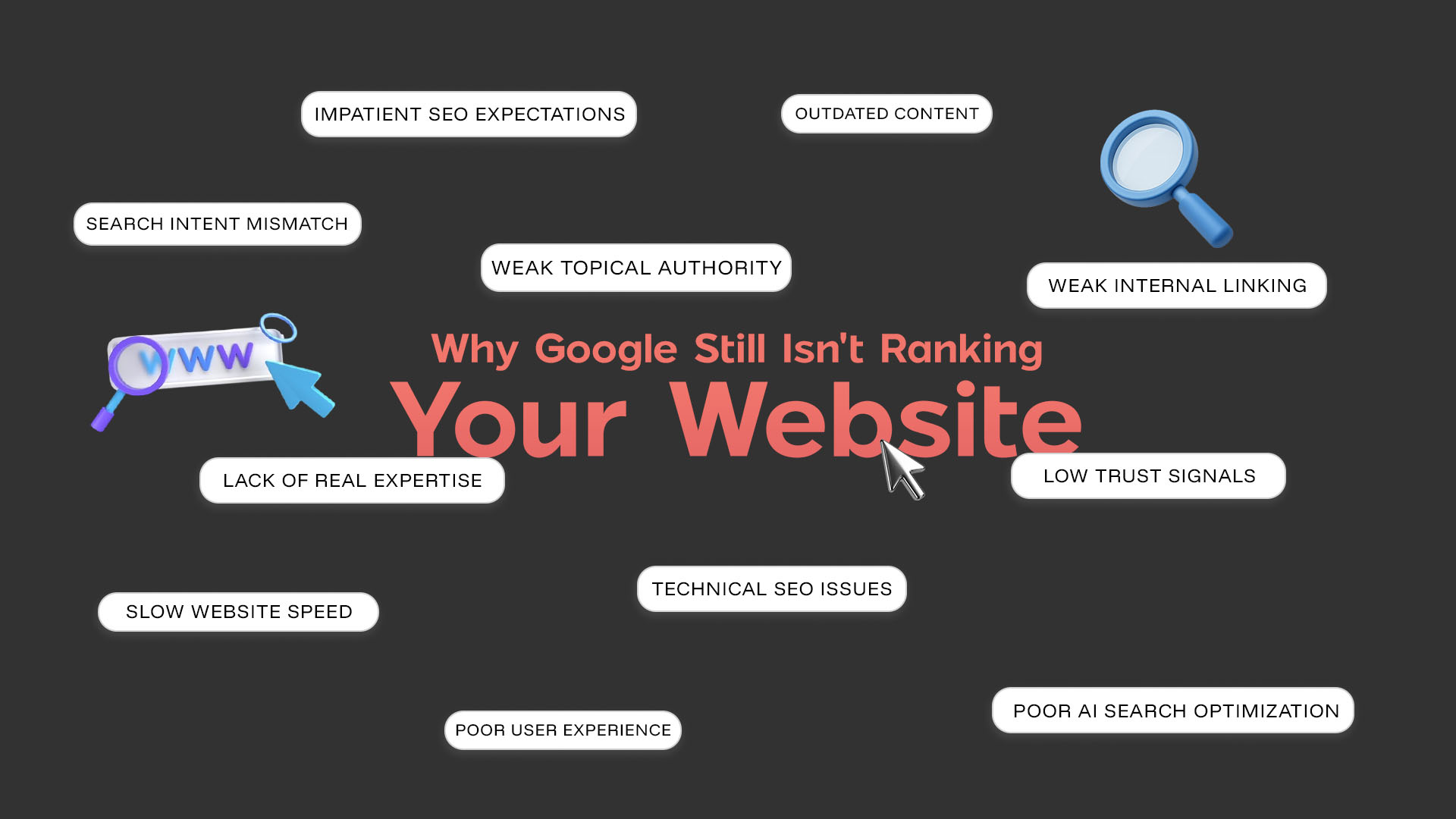
If your website still isn't ranking, chances are one (or more) of these issues is holding it back.
1. Your Content Doesn't Satisfy Search Intent
Ranking starts with understanding why someone searches, not just what they search. For example, someone searching for "best CRM software" expects comparisons, pricing, pros and cons, and recommendations, not a generic service page.
Before creating content, ask yourself:
- What problem is the user trying to solve?
- What type of content already ranks?
- Can I provide a more helpful answer?
When your content aligns with search intent, Google is far more likely to reward it.
As AI-powered search continues to evolve, understanding how search intent differs across SEO, AEO, and GEO is becoming increasingly important. Read our AEO vs GEO vs SEO guide to learn how to optimize for all three.
Your competitors are getting the clicks you deserve. Let's change that.
2. You're Publishing Content Without Real Expertise
Generic articles no longer stand out. Google increasingly favors content that reflects real experience, industry expertise, and practical insights.
Instead of repeating information found on other websites, include:
- Client success stories
- Real project examples
- Original research
- Expert opinions
- Lessons learned from experience
Content backed by genuine expertise builds trust with both readers and search engines.
3. Your Website Has Weak Topical Authority
Publishing one blog every few months won't establish your website as an authority. Google prefers websites that cover an entire subject comprehensively. For example, if you offer digital marketing services, create interconnected content around SEO, Google Ads, website design, local SEO, content marketing, technical SEO, and AI-powered marketing strategies. The more complete your content ecosystem, the stronger your authority becomes.
Expert Tip: Instead of publishing unrelated blogs, build content clusters around your core services and connect them using strategic internal links.
4. Your Website Loads Too Slowly
Visitors expect websites to load almost instantly. A slow website increases bounce rates, reduces engagement, and sends negative signals to Google.
Common speed issues include:
- Large image files
- Poor hosting
- Unused JavaScript
- Excessive plugins
- Heavy animations
Fast websites create better user experiences and better rankings.
Stop guessing why your website isn't ranking. Get answers from SEO experts.
5. You're Ignoring Technical SEO
Even excellent content can struggle if Google can't crawl or understand your website properly.
Regularly check for:
- Broken links
- Crawl errors
- Duplicate pages
- Missing XML sitemap
- Incorrect redirects
- Poor URL structure
Technical SEO forms the foundation of every successful ranking strategy.
6. Your Website Isn't Optimized for AI Search
Google's AI-powered search experience has changed how users discover content. Instead of simply matching keywords, Google now summarizes information from trustworthy, well-structured sources.
To improve visibility:
- Answer questions directly.
- Use descriptive headings.
- Include FAQs.
- Add structured data where appropriate.
- Write concise, information-rich paragraphs.
Content that's easy for AI to understand is also easier for users to consume.
7. You're Not Building Trust Signals
Google wants to recommend businesses users can trust.
Simple credibility factors make a difference:
- Customer testimonials
- Case studies
- Team information
- Secure HTTPS website
- Updated contact details
- Clear privacy and policy pages
These signals reassure both visitors and search engines that your business is legitimate.
8. Your Internal Linking Strategy Is Weak
Many businesses focus only on backlinks while overlooking internal links.
Strategic internal linking helps Google:
- Discover new pages
- Understand content relationships
- Distribute page authority
- Improve user navigation
Every new blog should naturally connect to related service pages and supporting articles.
Every day your website isn't ranking is another day you're losing potential customers.
9. Your Content Hasn't Been Updated
Fresh content continues to perform better in competitive industries.
Instead of constantly publishing new articles, revisit older pages by:
- Updating statistics
- Refreshing examples
- Expanding thin sections
- Improving readability
- Adding recent industry developments
A well-updated article often outranks newer but less comprehensive content.
10. You're Measuring Rankings Instead of User Experience
Many businesses obsess over keyword positions while ignoring what actually matters: how visitors interact with the website.
Ask yourself:
- Are users finding answers quickly?
- Are they exploring multiple pages?
- Are they contacting your business?
- Do pages encourage longer engagement?
Google increasingly rewards websites that provide a satisfying user experience, not just optimized keywords. Also, check out How to Implement AEO and GEO in Your Marketing Strategy?
11. You're Expecting SEO Results Too Soon
SEO remains one of the most effective long-term marketing strategies, but it requires consistency. Successful websites don't rank. They publish one optimized page; they rank because they continuously improve.
The businesses winning organic traffic in 2026 consistently:
- Publish valuable content
- Strengthen technical SEO
- Build authority
- Earn quality backlinks
- Monitor performance
- Update existing pages regularly
SEO isn't a one-time project; it's an ongoing investment.
Google won't reward outdated SEO. It's time for a smarter strategy.
Frequently Asked Questions
1. How long does it take for a website to rank on Google?
SEO typically takes between three and six months to show noticeable improvements, depending on your competition, website authority, and content quality.
2. Can AI-generated content rank on Google?
Yes, but only when it provides genuine value, demonstrates expertise, and satisfies user intent. Generic AI content without originality rarely performs well.
3. How often should I update my website content?
Review important pages every three to six months to keep information accurate, relevant, and aligned with current search trends.
4.What is the biggest SEO mistake businesses make in 2026?
Creating content solely for search engines instead of solving real customer problems remains one of the biggest reasons websites fail to rank.
Final Thoughts
If your website isn't ranking on Google in 2026, the solution usually isn't adding more keywords; it's creating a website that genuinely deserves to rank. Focus on producing helpful, experience-driven content, improving your website's technical health, strengthening topical authority, and delivering an exceptional user experience. These are the factors that help businesses earn sustainable rankings and long-term organic traffic.
Rather than chasing quick SEO wins, invest in building trust, expertise, and value. That's what Google rewards and what your customers are looking for.
Your next customer is searching on Google. Make sure they find you first.